April 27 marked the 55th anniversary of the death of a prominent
representative of the Bukovinian diaspora, a diplomat, public and political figure,
scholar, lecturer, and one of the creators of the Ukrainian national revival -
Roman Smal-Stotsky.
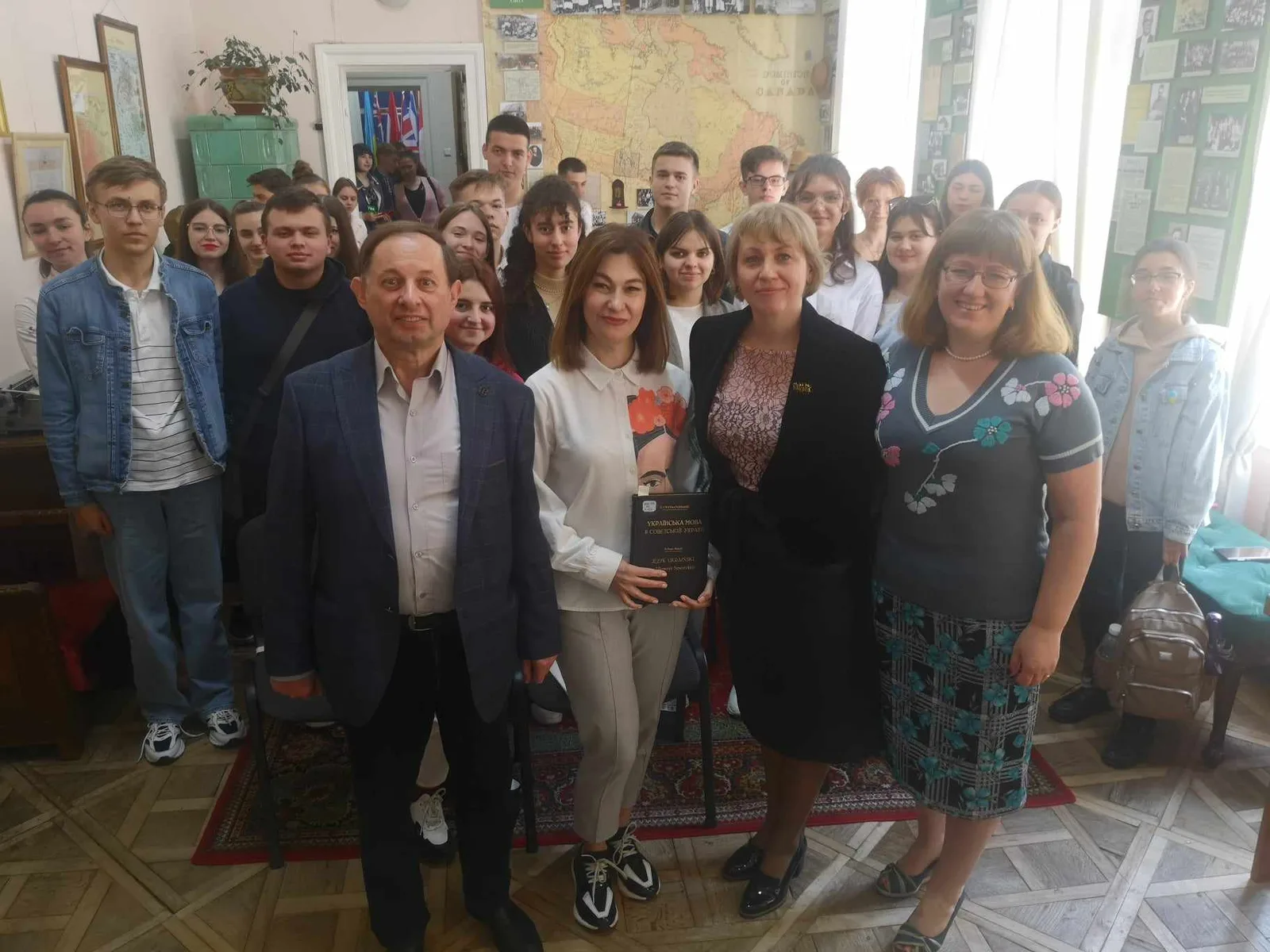
On this occasion, a memorial evening dedicated to the memory of the Bukovinian was held in the exhibition of the "Bukovinian Diaspora" department.
The son of the renowned Ukrainian linguist, historian, and
educator Stepan Smal-Stotsky, Roman fully realised himself as a political
figure who made a significant contribution to preserving Ukrainian identity in
emigration. The period of his active political, public, and educational activities
coincided with Ukraine's struggle for independence. And such people always
posed a huge danger and threat to opponents of a free and independent Ukraine.
Olexandr Dobrzhansky, Dean of the Faculty of History, Political Science and
International Relations, Doctor of Historical Sciences, Professor at Chernivtsi
National University (ChNU), spoke about the life and work of the diplomat and
scholar. He emphasised that such a prominent figure deserves the respect and
attention of contemporaries, and his activities and achievements, especially in
such difficult times, are essential for study.
Even in his youth, during the First World War, Roman
Smal-Stotsky was an active member of the Union for the Liberation of Ukraine,
participating in the organisation of cultural and educational activities for
Ukrainians in prisoner-of-war camps in Germany. The work carried out in such
camps at that time was extremely important both for maintaining the morale of
the prisoners and for fostering their awareness of being part of the Ukrainian
nation. Tetiana Minaieva, head of the "Modern History" department, spoke about this stage in Roman Smal-Stotsky's life.
In late 1918, Roman Smal-Stotsky was appointed
diplomatic representative of the West Ukrainian People's Republic (ZUNR) in
Berlin. After the Act of Unification of the ZUNR with the Ukrainian People's
Republic (UNR) in January 1919, he became an advisor, and in 1921, an
ambassador at the UNR embassy in Berlin. Roman held this position until the
embassy's closure in March 1923, after which he moved to Prague where he became
a professor at the Ukrainian Free University.
From late 1924 until the beginning of the Second World
War, Roman Smal-Stotsky held the position of professor of Ukrainian linguistics
at Warsaw University and secretary of the Ukrainian Scientific Institute in
Warsaw, as well as being the editor of its publishing house. Concurrently, he
held various positions in the UNR government in exile, including UNR ambassador
to the Polish government, Minister of Culture, Minister of Foreign Affairs, and
Vice Prime Minister. From 1926–1939 (and also in 1946–1947), he chaired the Promethean
League. Roman Smal-Stotsky considered Russian Bolshevism to be the greatest
enemy of Ukrainian nationhood, and therefore initiated the League of Peoples
Enslaved by Moscow, which included representatives from Georgia, Azerbaijan,
Turkmenistan, Crimea, Kuban, Karelia, and others.
Unfortunately, the museum does not possess original
documents or works by Roman Smal-Stotsky, but archives and, of course, libraries
also contribute to preserving the memory of prominent individuals. Larisa
Vornik, Chief Librarian of the ChNU Scientific Library, presented a unique
collection of works, among which is Roman Smal-Stotsky's book "The Ukrainian
Language in Soviet Ukraine," published in Warsaw in 1936. It is preserved in
Vasyl Symovych's archive and contains an inscription from Roman Smal-Stotsky!
With the opening of KGB archives, new interesting facts
have come to light, demonstrating the significant role played by the Bukovinian
in the establishment of Ukrainian statehood.
After
the Second World War, with a new wave of Ukrainian emigration, Smal-Stotsky
fully demonstrated his abilities as a scholar and organiser. From 1947, he lived in the USA. In 1955,
he became president of the Main Council of Scientific Societies named after T.
Shevchenko, and from 1957, he headed the Scientific Society named after T.
Shevchenko in the USA. For a long time, he worked as a professor at Marquette
University in Milwaukee, Wisconsin. He founded a Slavic institute at this
university, which Roman Smal-Stotsky led until his death in 1969. Larisa
Vornik presented Roman Smal-Stotsky's book from Arkady Zukovsky's library,
published in that very city in 1952, titled "The National Problem of the Soviet
Union and Russian Communist Imperialism."
In 1964, Roman Smal-Stotsky became the Head of the
Shevchenko Monument Committee (SMC) in Washington. The odyssey that the
Ukrainian community in America had to undertake at that time is extremely
interesting and deserves a separate article. Thanks to the coordinated work of
the team led by Roman Smal-Stotsky and the entire Ukrainian community, a large
sum of money was collected and extensive work was carried out in a short period
to ensure this monument appeared in the US capital. A copy of a photo
testifying to this historical event is preserved in the exhibition of the
"Bukovinian Diaspora" department.
Ukraine, the Ukrainian language, and national identity
were always paramount for him! Despite being gravely ill, Roman Smal-Stotsky
consciously spent a large sum of money, which the Ukrainian community had
raised for his treatment, on reissuing his book "The Ukrainian Language in
Soviet Ukraine." It was published in 1969.
In the year of his death…