Author: Oksana Dragomyretska
No civilized country can be imagined without
a well-developed network of roads and railways. Thus, it is natural that with
Bukovina's incorporation into the Austrian Empire, the government's primary attention
was given to laying and improving roads in the region to establish connections with
other provinces. The construction of a railway, which would significantly
accelerate trade and stimulate economic growth, was no less relevant.
In mid-December 1863, as reported by the newspaper
«Bukowina», English engineers "in a remarkably short time" completely prepared
the general railway project. And already in January 1864, a construction contract
was signed in London as a result of negotiations, under which the English side,
represented by Thomas Brassey, undertook to build the railway within a specified
period for 24.5 million guilders. The construction itself began in May 1865. To
supervise the construction, the company's board of directors created two departments
– one in Lviv and the other in Chernivtsi. The conditions under which the
construction proceeded were unfavorable: famine and a cholera epidemic in
eastern Galicia and Bukovina, an unsuccessful war with Prussia, and related
disruptions in the supply of building materials. Despite this, in an
unprecedentedly short time (less than 16 months), six months ahead of schedule,
on September 1, 1866, the 266.6-kilometer railway was opened for traffic – the
only one built in the monarchy that year. And already from the autumn of 1866,
requests began to arrive in Vienna from Bukovina regarding the construction of
the Chernivtsi – Suceava railway section. Construction of the
Chernivtsi-Suceava section, begun in the autumn of 1867, progressed rapidly, and
already on October 28, 1869, a train departed from Suceava for Chernivtsi,
initiating traffic on this 89.9-kilometer section.
Over the next two decades, a
number of local and regional railways joined this main line. According to 1899
statistics, the total freight traffic on the region's operating railway network
amounted to 7 million tons. And over the year, more than 1 million 500 thousand
people were transported on all Bukovina railways.
In 1865, a railway station was built in Chernivtsi. The
first Chernivtsi station was built according to a typical project, similar to
stations in Vienna, Lviv, and Stanislav (Ivano-Frankivsk). Construction took
place during the tenure of Chernivtsi's first burgomaster, Jakob von Petrovich.
On September 1, 1866, the first train "Lviv –
Chernivtsi" arrived in Chernivtsi. This ceremonially opened the Lviv –
Chernivtsi section of the main line of the Royal Austrian State Railway Lviv –
Chernivtsi – Suceava (completed in October 1869), thereby making Bukovina an
area of international connection.
The accident that occurred
in Chernivtsi on the railway bridge on March 4, 1868, at 6:30 AM, gained
widespread notoriety at the time. The passenger train "Chernivtsi – Lviv" departed
from the platform in Chernivtsi. It was a mixed train of 16 carriages. Ahead
were 10 freight wagons, primarily carrying livestock. When crossing the
railway bridge, as the first locomotive was already on the opposite bank, the
right side of the bridge cracked, followed by the left, and the locomotives
began sliding down the incline into the water, followed by the freight wagons.
Three engineers also fell into the water; one of them, named Geld, despite
broken ribs, managed to save his colleagues. Passengers were not harmed in this
accident, as behind the freight wagons were the mail, 4 passenger, and
conductor's carriages. The conductors did not lose their composure and managed
to brake the passenger carriages. As a specially created commission
established, the cause of the accident was the use of a large amount of cast
iron, cheaper and less strong than wrought iron, in the bridge's construction.
Therefore, bridges built according to engineer Schifferkorn's designs were
subsequently either reinforced or replaced. It should be noted, however, that
the bridge over the Prut River had a very attractive, even imposing appearance
and was the pride of the Bukovinians, especially the Chernivtsi residents. This
bridge was photographed for foreign magazines as an original structure.
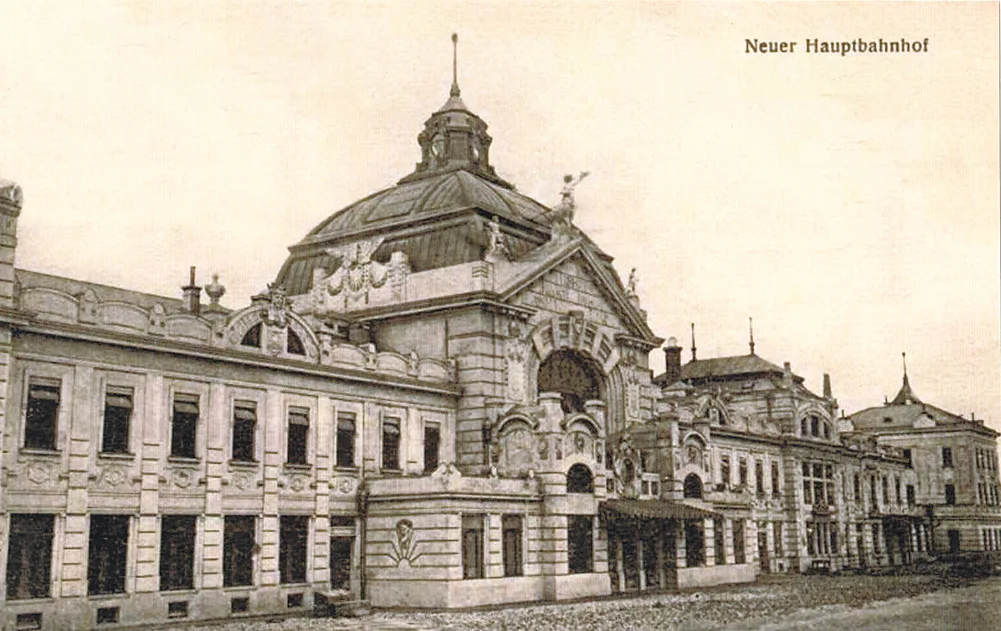
A new railway station in Chernivtsi – a true pearl of Viennese Modernism – was erected 40 years later on a new site. Chernivtsi residents aspired to have a railway station that would match the status of the regional capital and be capable of accommodating the most esteemed and demanding guests. A significant contribution to the construction of the new station building was made by Benno Straucher, a member of the Austrian Parliament and the Bukovinian Sejm (now an honorary citizen of the city), who became one of the initiators and organizers of the project and was part of the body that supervised the construction progress.
During 1904–1905, the railway directorate purchased
plots in the area of the future construction, and already in March 1906, the
«Czernowitzer Zeitung» newspaper reported that the new station building,
according to the assurances of the project's author, Mr. Otto Wagner, would
meet all modern requirements.
The cornerstone for the new station's foundation was
ceremonially laid on September 16, 1906, with the participation of Austria's
Minister of Railway Transport, Dr. Julius Derschatta von Standhalt, Counselor
Dr. Hnidey, ministry officials, and Bukovina's regional president, Dr. Octavian
Regner von Bleyleben, regional marshal Baron Georg von Wassilko, burgomaster
Eduard Reiss, and a large Chernivtsi community. The construction site was
consecrated by Archbishop Dr. Vladimir von Repta.
Construction was carried out under the supervision of
Chernivtsi architect Moritz Elling, based on the design of the world-renowned
architect and founder of the Classicist direction of Viennese Secession, Otto
Wagner. As the construction site was once a swamp, strong concrete foundations
were laid for the structure. The building was erected in 3 years and 2 months.
The opening of the new railway station took place on
November 30, 1909, at 12 o'clock (noon). The building was put into operation
without any ceremonies. Special thanks for supervising the station's
construction work were extended to the technical director, Counselor Dr. Chigfrey,
the involved institutions, and the contractors.
The railway station was built in the Art Nouveau style,
equipped with the latest achievements in transport communication. The two-story
building has the form of an elongated rectangle with a raised central part.
Above the station entrance, a sculptural composition of 5 figures was
installed, at the center of which (at the very top of the pediment) is the
radiant Iris, the messenger goddess with a raised hand. On both sides, she is
surrounded by four angels. One pair holds flowers in their hands, while the
other two are depicted with arrows. The dome above the central entrance and
lobby is raised to a height of 20 m. The central hall is an oasis of comfort
and bright elevation. Its ceiling and walls are decorated with gilded floral
ornaments, lush garlands intertwined with grape clusters, leaves, and rose
blossoms, and among them – female heads and masks. The wall decoration
concludes with stylized wheels, symbolizing the continuity and endlessness of
movement.
The two-story building, constructed in the form of an
elongated rectangle with a raised central part, was 151 m long and featured a
seven-meter asphalted platform for passengers. For freight transportation, a
warehouse, a transport office, and a freight platform were built. The cost of
building the station amounted to 1381 thousand kronen.
Here's how the newspaper «Narodnyi Holos» (People's
Voice) reported on the commissioning of the new railway station building: "The
new railway palace in Chernivtsi has now been opened for public use. Now,
anyone departing from Chernivtsi must board the train from the new palace, and
likewise, anyone arriving by train must alight here."
According to Austrian architect Margarete
Viorel-Czapk from Vienna, "the station in Chernivtsi belongs to the mature
phase of Secession architecture. It was built between 1907–1909 and replaced the
previous structure from 1866. In its overall concept, it belongs to the
tradition of large stations of the second half of the 19th century... However,
at first glance, it is undoubtedly recognizable as a Secession creation:
clearly contoured cubic forms, the articulation of the framework formed by
columns and window axes, sparse decor with crowned pylons and the main emphasis
on the domed completion of the central hall, with the main through-vestibule
opening with a monumental circular arch and crowned by a triangular pediment."
And today, Chernivtsi station – the city's main railway
station, designed according to the best European models – is an architectural
monument of local significance and one of the most beautiful stations in
Ukraine.