Authors: Oksana Rotar, Andriy Fedoruk
340 years ago, on September 12, 1683, outside the walls of the Austrian capital, the last of the most grandiose battles between Christian Europe and the Muslim East – the Battle of Vienna – ended. In it, the combined military forces of the Holy Roman Empire and the Polish-Lithuanian Commonwealth inflicted a crushing defeat on the army of the Ottoman Empire. The victory achieved finally put an end to Turkish expansion in Central and Eastern Europe and significantly strengthened the power of the Habsburg monarchy on the continent. The fateful Battle of Vienna also involved natives of the Bukovinian lands.
Until recently, the participation of our compatriots in the battle for the "golden apple"
of Europe, as Vienna was called according to one legend in Ottoman ruling circles, was completely
unknown. For a long time, there was no mention of it in Bukovinian studies literature. For
example, Eduard Fischer, an officer of the regional gendarmerie, in one of his local history
essays, only briefly mentioned that the Moldavian hospodar Gheorghe Duca "also participated
with his military units in the Turkish campaign against Vienna in 1683, but lost his camp
and the core of his units during the counterattack." In turn, the Ukrainian historian Arkadiy
Zhykovsky only casually noted that "the Ottoman Empire became noticeably powerless, and
after the defeat at Vienna in 1683, and even more so after the Treaty of Karlowitz in 1699,
it was in constant retreat." The obvious purpose of all these testimonies was a simple
justification of a certain regularity as to why the Bukovinian territories subsequently
came under the rule of the Habsburg monarchy, which in principle does not contradict, but
fully corresponds to historical reality.
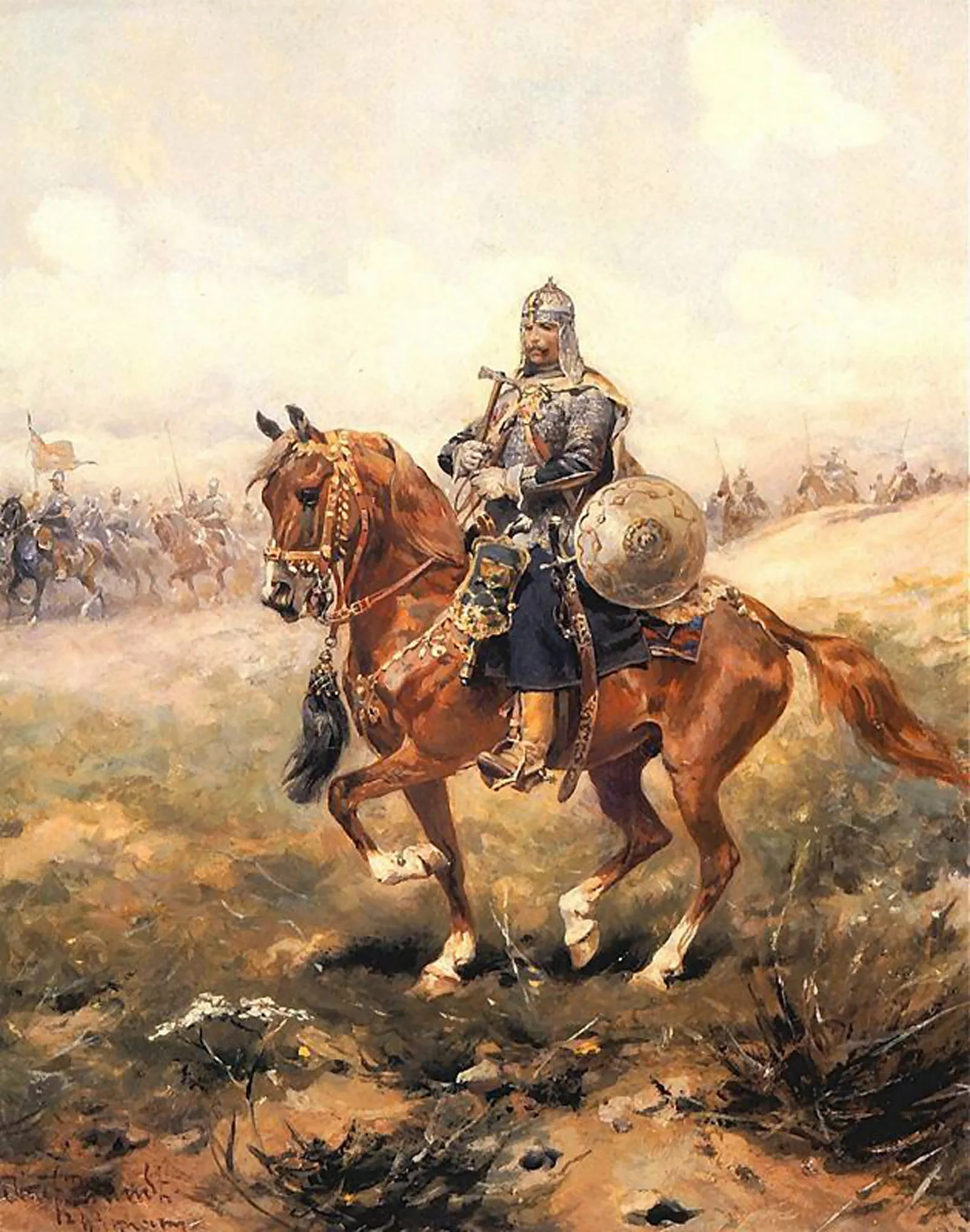
Hussar in plate armour.
Artist Józef Brandt.
But exactly who among the local population was part of the Moldavian units, as auxiliary parts of the Ottoman army under the walls of the Austrian capital, remains unknown. However, valuable documentary evidence has survived to our time, clearly demonstrating that many Bukovinians then served in the army of the Polish King Jan III Sobieski, where, by his order, separate units of light cavalry – "Wallachian banners" – were formed from them.
It is known that in the last third of the XVII century, the Bukovinian territories found themselves in a zone of almost constant hostilities between the Ottoman Empire and the Polish-Lithuanian Commonwealth, which were actively engaged in armed struggle for domination over Right-bank Ukraine and Moldavia. Under these conditions, many representatives of the small and medium Moldavian nobility joined the Polish army. Subsequently, a sufficiently massive exodus of compatriots to foreign service attracted the attention of some eyewitnesses of this process. In particular, the chronicler Ion Neculce wrote in connection with the events of the 1680s that almost all Moldavians, "our boyars and boyar servants, retainers" went to Poland. And in modern times, the Romanian historian Nicolae Iorga also noted that "many Moldavians from the upper part of the country, occupied by royal troops" went to Polish military service. Thus, at the end of the XVII century, many officers and soldiers in the light cavalry banners of Jan Sobieski's army were from Chernivtsi and Khotyn volosts.
The most complete information about the armament and equipment of the personnel of the
"Wallachian banners" has been preserved in the description of the Italian Sebastiano Cefali,
secretary to Prince Jerzy Lubomirski. "They are lightly armored," he wrote, "a bow, pistol,
and sabre (more precisely, a scimitar) are their weapons. Some of them have carbines instead
of bows, commanders wear cuirasses (this refers to chainmail)." Also, "Wallachians" served in
other types of Polish cavalry, ranging from the exotic "Janissary banner" – Jan III Sobieski's
life guard – to Cossack and hussar units. The "Wallachian banners" played primarily an auxiliary
role on the battlefield compared to the more numerous and better-armed armoured divisions, not
to mention the hussars – the elite cavalry of the Polish-Lithuanian Commonwealth army. The
"Wallachian banners," like the Cossack units, were primarily intended for "podjazdy" – reconnaissance
and diversionary actions, fighting similarly armed enemy detachments, pursuing defeated opponents,
and so on.
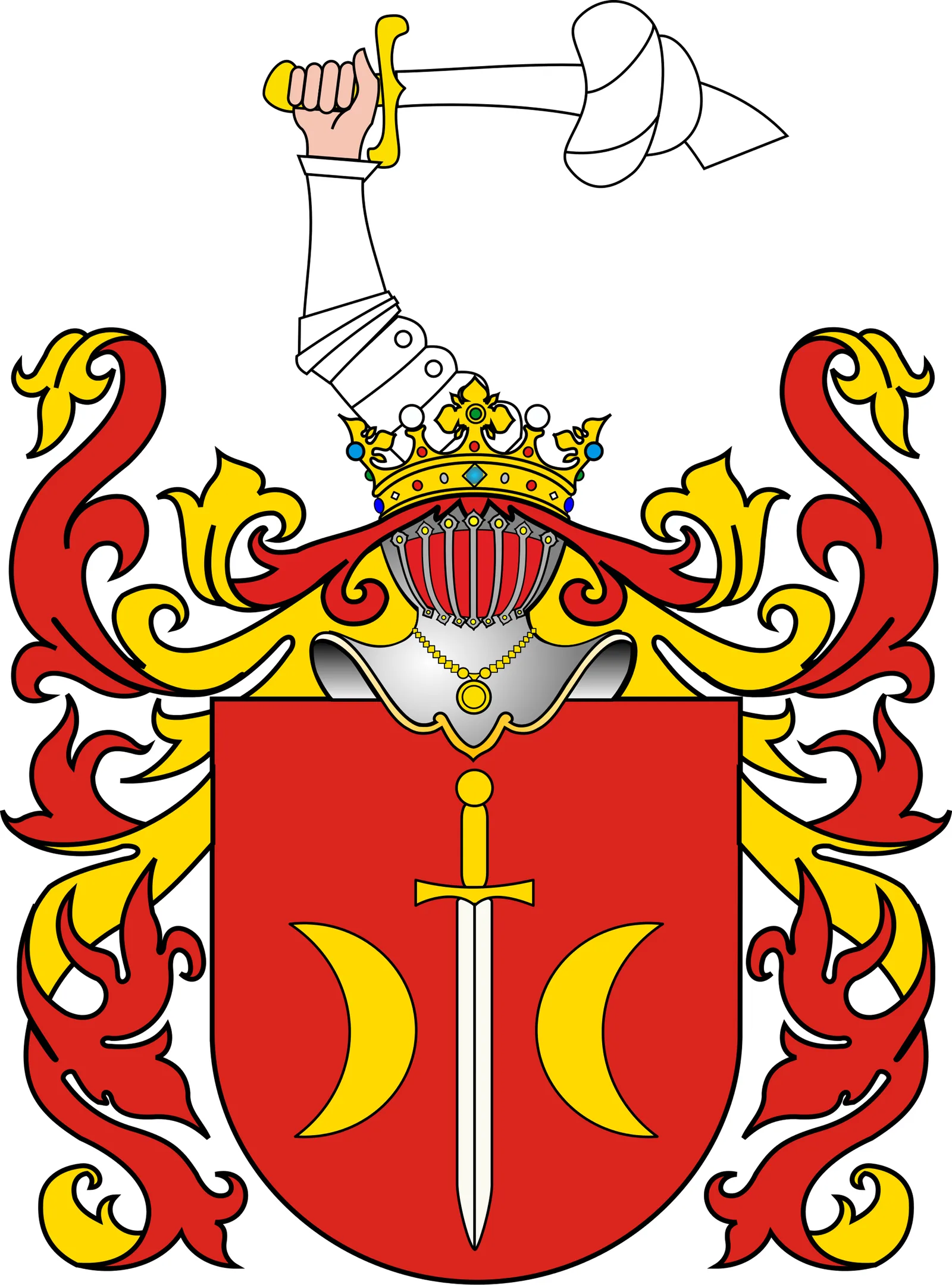
Coat of arms of the noble
Turkul family.
Colour reconstruction.
Regarding Bukovinians who personally participated in the battle for the "golden apple" of Europe, first and foremost, Gheorghe Ghizdeu (Khizdeu or Khijdeu) should be named – one of the ancestors of prominent figures of Moldavian and Romanian culture of the XIX – early XX centuries: Alexandru, Boleslav, and Thaddeus Khizdeu (Bogdan Petriceicu Hasdeu). According to the Polish army's register for "the expedition to relieve Vienna in 1683," he was a rotmistrz of one of the "Wallachian banners" comprising 70 soldiers. It is quite possible that other of our compatriots were part of it, as his unit belonged to the newly formed ones (the so-called "new levy"). Indirect evidence of this is also the fact that Gheorghe's son, Vasily, and his nephew, Gheorghe-Lupașcu, also later became Polish rotmistrzs. The latter, during his service in the royal army, married a Pole with whom he had three sons, and owned the village of Konyushki in the Przemyśl Voivodeship. Gheorghe-Lupașcu Ghizdeu died as a Polish rotmistrz in 1733, bequeathing his sons "my sabres and the glory of my ancestors" and urging them: "Fight the cursed infidel, and you will be blessed. And whosoever among you bows to the Turk and returns to his allegiance, let him be cursed." It is also known that the Ghizdeu family owned estates compactly located in the Khotyn region. These were the villages of Pashkivtsi, Tulburyany (now Krutenky), Chytnykivtsi, or Ghizdeu (now Yarivka), Nahoryany, Nesvoya, Dolynyany, half of Kruhlyk, Hrushivtsi, Nehryntsi, a third of Shyndryany (now Dranytsia), and others.
By the way, for the successful combat activities of the "Wallachian banners" during the
repulsion of Turkish-Tatar attacks, a number of "Wallachians" were honored at a high state
level several years before the Battle of Vienna. During the coronation Sejm in Krakow in 1676,
Jan Sobieski himself signed a series of acts, according to which some of them received Polish
nobility. Among these recipients, "who under various circumstances rendered us (the king) and
the Commonwealth significant service," was Gheorghe Ghizdeu. Each of them received a royal
diploma of nobility with a coat of arms and a text enumerating the merits and personal qualities
of the ennobled person. In particular, Rotmistrz Vasile Turcul, father of the well-known royal
Rotmistrz, and later Colonel Konstantyn Turcul (Turkulets) – General Judge and administrator
of the Chernivtsi starostwo – was assigned to the Ostoya coat of arms group. On one of the
variants of the Turcul coat of arms: an armored arm bent at the elbow, holding a yatagan with
an impaled turban, protrudes vertically from the crown. In addition, at the same time, representatives
of the Bukovinian families Lukavetsky, Davydel, Barbovsky, Murhultsev, Volchynsky, Kokoran, etc.,
also served in the army of King Jan III Sobieski and received ennoblement.
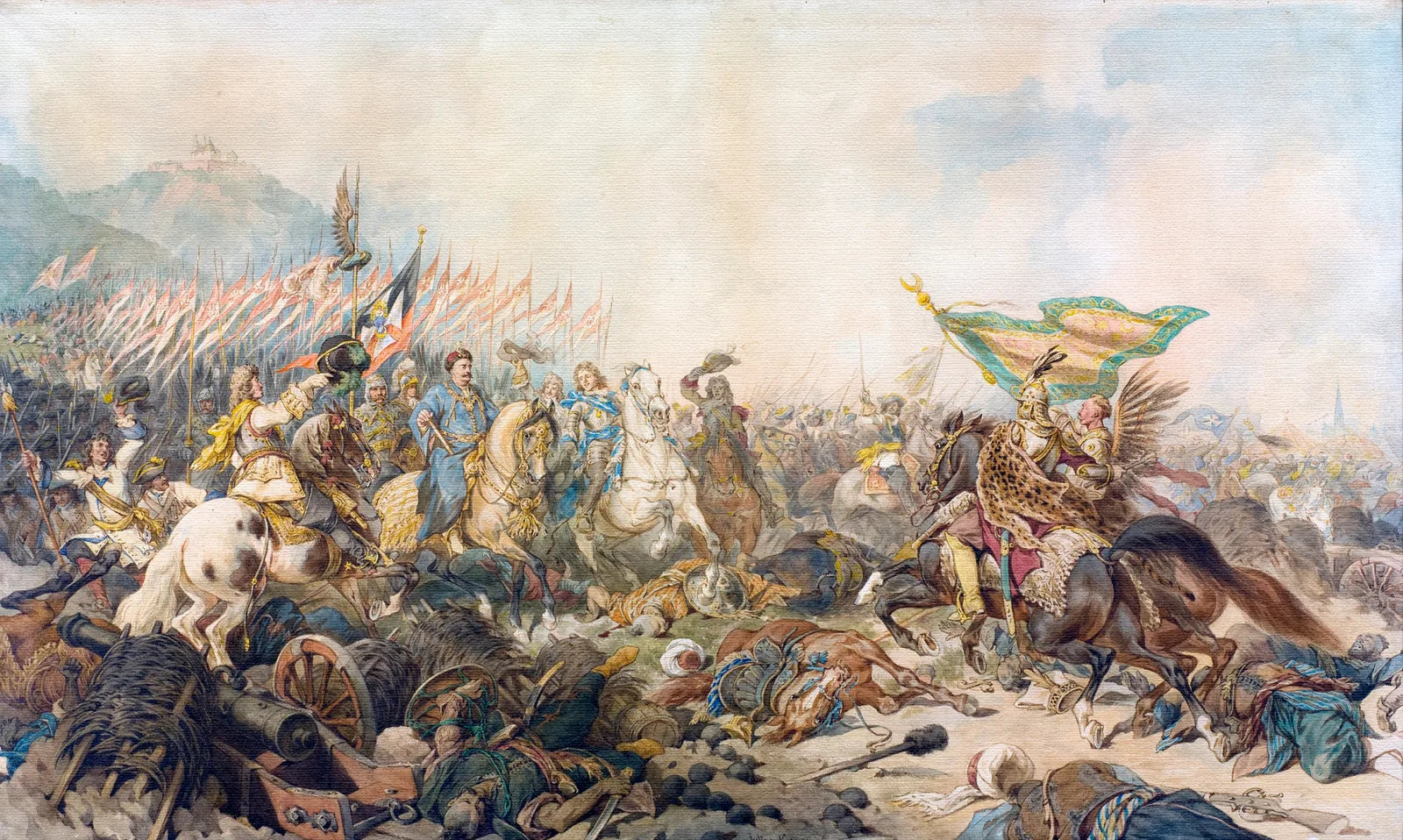
Jan III Sobieski at Vienna.
Artist Juliusz Kossak.
Another native of the Bukovinian lands who participated in the Battle of Vienna in 1683 was Rotmistrz Apostol Kigech, who for some time owned a quarter of the village of Putyliv. In the Polish army, he commanded a private Cossack banner of the Volhynian Voivode and Field Hetman of the Crown, Mykola Sieniawski, which numbered 150 men. The already mentioned K. Turcul, who was a relative of A. Kigech, characterized him as – "of good origin, a Wallachian by birth and truly Orthodox, in all respects an extraordinary person, especially skilled in knightly affairs." In the battle outside the walls of the Austrian capital, his cavalry unit was positioned on the left wing of the Polish army, commanded by his patron. Soldiers under Apostol Kigech's leadership attacked the enemy at the decisive moment of the battle, when, by Jan Sobieski's order, the entire cavalry of the Polish-Austrian-German army moved into offense, delivering a powerful blow that utterly routed the Ottoman army.
Thus, the participation of Bukovinians
in the battle for the "golden apple" of Europe as part of the Polish army was conditioned by
various life circumstances, as different objective and subjective reasons pushed them to take
such a step. Among them were those who simply sought "a soldier's bread," as they possessed
insignificant landholdings bordering the territory of the Polish-Lithuanian Commonwealth. But
a significant number of them were political emigrants who deliberately pursued an anti-Turkish
course, orienting themselves towards Poland. Therefore, in the fateful Battle of Vienna, they
fought not so much for the king as for the "glory of their ancestors" and the "Christian faith"
of their forefathers.