Authors: Oksana
Rotar, Oksana Dragomyretska, Andrii Fedoruk
Among the sites of the Chernyakhov culture, the burial ground located near the village of
Oselivka, Dnistrovskyi (formerly Kelmenetskyi) district, Chernivtsi region,
is one of the well-known archaeological sites. Valuable artifacts have been
recorded there, making it possible to trace the direct influence of Roman military
culture on the military affairs of the local population in the Late Antiquity period.
Of particular interest is a ritualistically bent sword, found during the 1977
excavations at a depth of 0,55 m in burial 70, which, judging
by other weapons found there, contained a funerary urn with
the cremated remains of a warrior. Currently, this ancient blade, which is preserved in
the collections of the Chernivtsi Regional Museum of Local Lore, is displayed in its
exposition among archaeological items of regional significance.
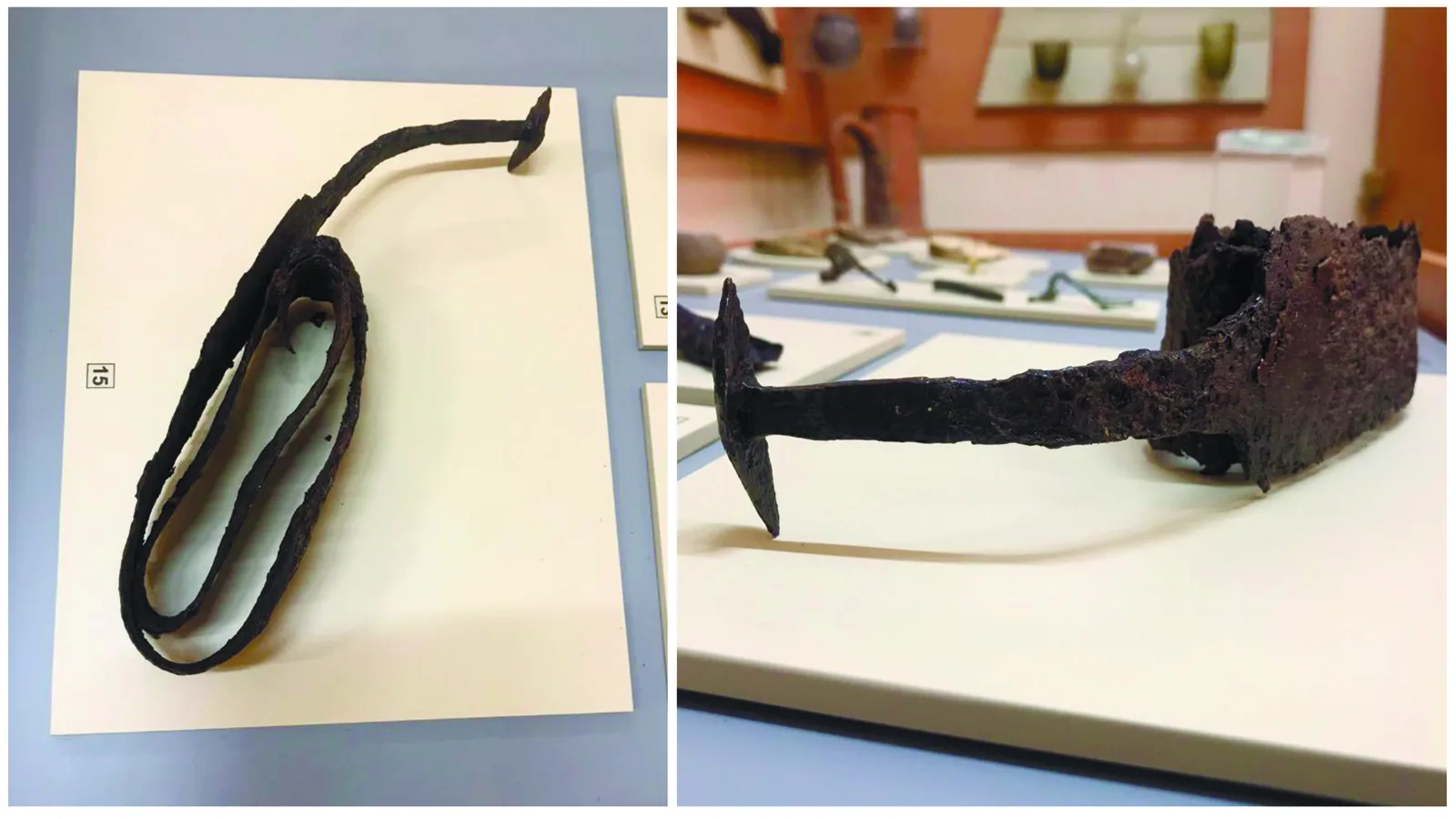
Sword from
the Chernyakhov burial ground near Oselivka village.
Modern photos.
The structural and morphological
parameters of the investigated sword are as follows: total length –
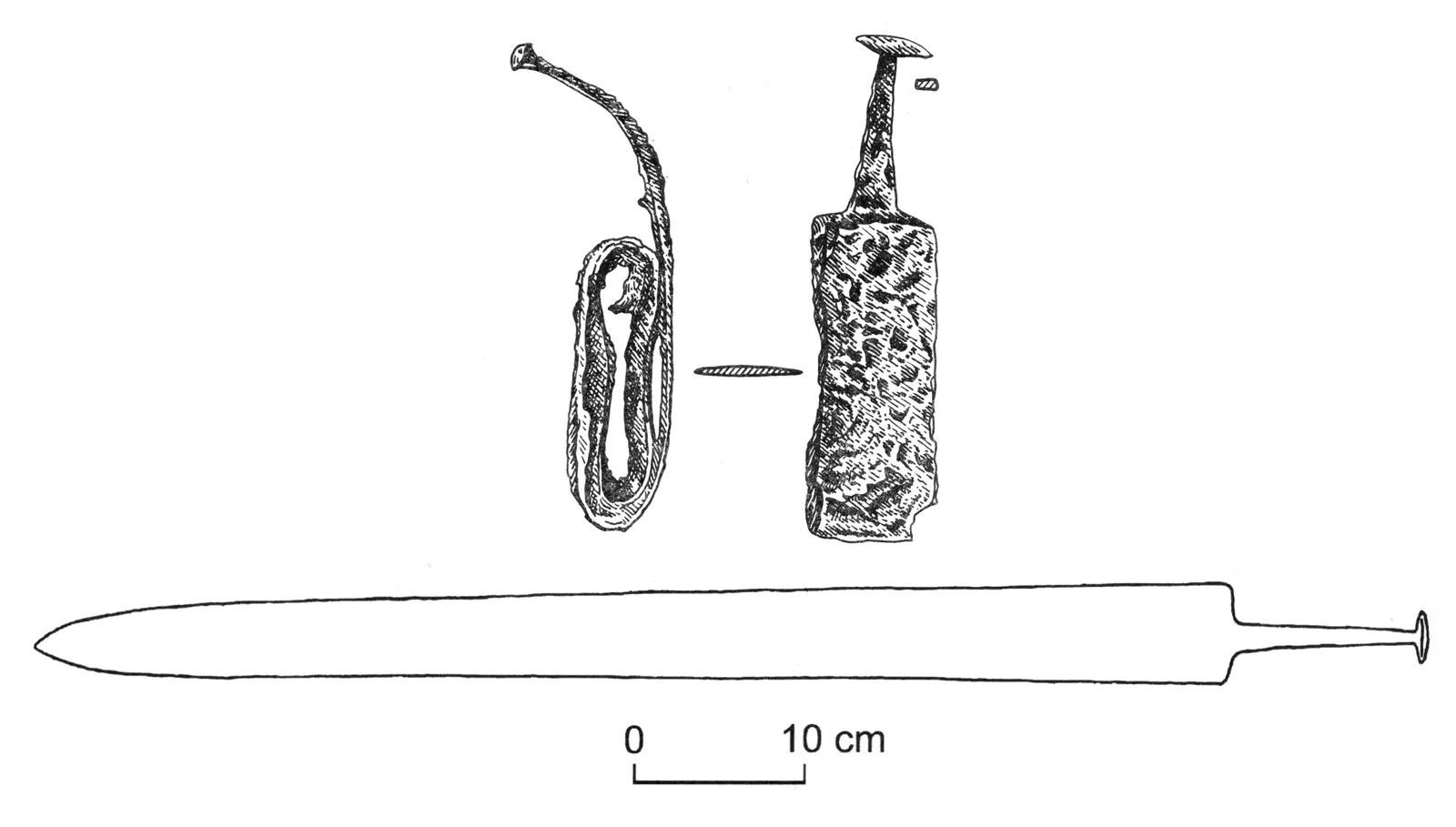
Drawing and reconstruction of the Oselivka sword
(after H. Nikitina; M. Levada)
Based on the external features presented, certain analogies to the sword from the
Oselivka burial ground can be found in blades discovered at other Chernyakhov
sites – the Kompaniivka burial ground (Kobeliaky district, Poltava region,
Ukraine) and the Budesti settlement (Criuleni district, Moldova), as well as those
found in the area of Razgrad (Razgrad region, Bulgaria), where modern
researchers localize the site of the great battle of Emperor Trajan Decius
with the "Scythians" in 251 CE. Furthermore, metallographic analysis
of the investigated blade showed that the type and quality of the metal, and
its processing methods, indicate a high level of craftsmanship, which involved
the application of appropriately complex technological techniques for
manufacturing such a sword. The latter was made from so-called "pattern-welded
metal" – from iron and steel strips welded together. Moreover, such a
manufacturing technology testifies to a fairly high skill level of the armourer.
This gives every reason to assume that the blade from the mentioned Chernyakhov
burial ground is an item produced in Roman workshops, which made swords of
high technical quality.
Judging by its general
appearance, the found blade from the Oselivka burial ground can be attributed
to the type of Roman long sword – the spatha – which was widespread among
barbarian tribes in the mid-3rd – 6th centuries CE.
Its widespread distribution in the territory of Eastern European
Barbaricum can also be explained by the fact that in the late 2nd – early 3rd
centuries CE, the traditional gladius in the Roman army gave way
to the spatha. According to Vegetius, "large swords, which
were called spathae, and others, smaller, which were called semispathae,"
were fully established in the legions even before the era of Emperor
Diocletian. Moreover, the tang of the hilt of the blade from the Oselivka
burial ground, characterized by widening at an obtuse angle at the transition
to the blade, indicates a corresponding hilt configuration. According to Mike
Bishop's classification, it belongs to the so-called "Roman Late Imperial type,"
dated to the mid-to-third quarter of the 3rd century CE – the period of the Late
Principate, and significantly differed in shape from the "T-shaped" hilt of
the Dominate period (late 3rd – 6th century CE), in
which the tang joined the blade's base at a right angle. Thus,
chronologically, the dating of the sword from the Oselivka burial ground falls
at the apogee of the "Scythian Wars" (232 – 276 CE) in the Lower
Danube region, which served as a certain external backdrop for the formation of
the general area of the Chernyakhov culture.
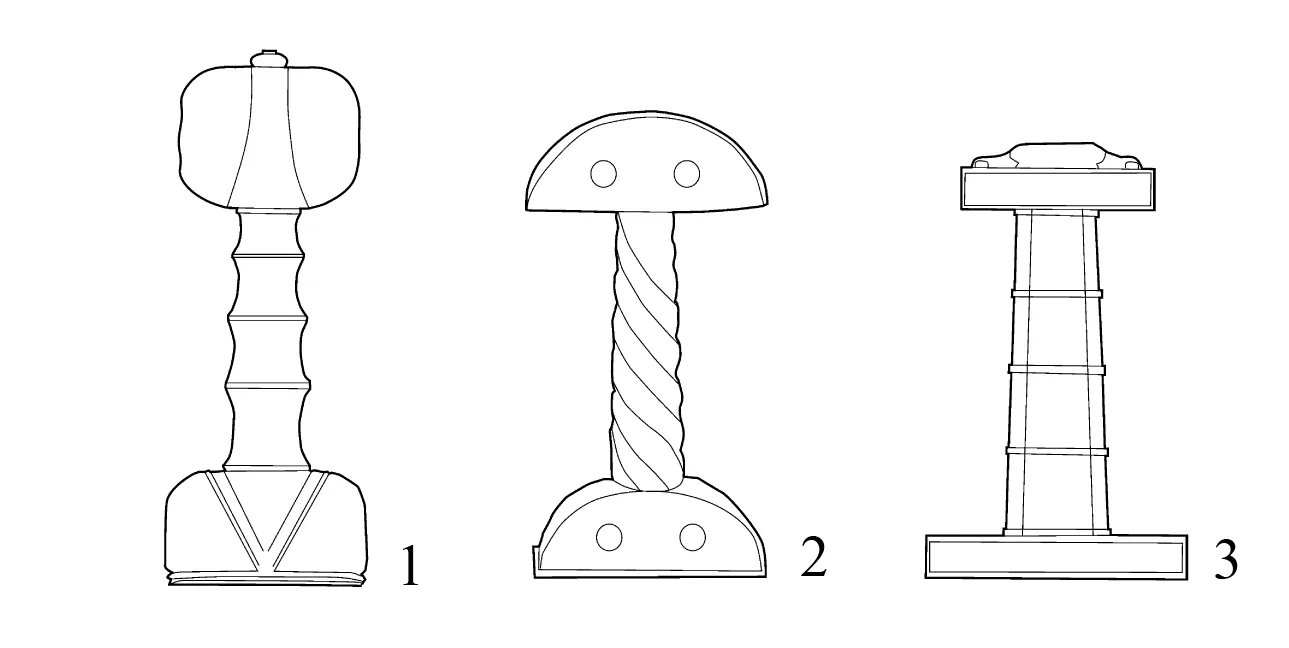
Types of Roman spatha hilts from the 1st – 6th centuries CE (after M.
Bishop):
1 – Principate era (1st – 2nd centuries CE); 2 – period of the
Empire's crisis in the 3rd century CE;
3 – Dominate era (4th – 6th centuries CE).
Overall, it can be stated that during this period, long swords were
widespread among barbarian tribes, which also differed in blade type. The first
type consisted of spathae that had an unprofiled blade with a flattened
elliptical cross-section. In literature, this type of sword is classified
under the name "Pompeii" type, after the location of
the first such blade discovery. Other types of spathae had blades
profiled with longitudinal grooves – fullers – which enhanced the rigidity of
the working parts of the swords. Therefore, it can be confidently stated that
the sword from the Oselivka burial ground, by its morphological
characteristics, clearly belongs to the first type of blades.
It is not easy
to ascertain the path of appearance of such a rare item of Roman military
culture. However, Halyna Nikitina's assumption that the way such a blade
entered the territory of the Middle Dniester region was most likely through
import appears quite plausible. Whether this sword was brought as a war trophy
or for some trading operations is impossible to state unequivocally.
Nevertheless, it should not be ruled out that the buried owner of the sword
from the Oselivka village burial ground, whose blade is distinguished by a
remarkable level of technological execution, might also have served in the
Roman army for some time. The involvement of barbarian contingents from among
the participants of the "Scythian Wars" continued until the 270s CE
inclusive. For instance, preserved fragments of Dexippus's historical work
report on Emperor Aurelian's peace negotiations with Eastern Germanic tribes. As a
result, "from that time on, two thousand cavalry from the Vandals served in the
Roman army. Some were chosen from the entire people and enrolled as allies, others voluntarily entered Roman service." As
mentioned above, the investigated sword from burial 70 of the Chernyakhov
burial ground near Oselivka was found in a bent state in accordance with a
ritual characteristic of the Przeworsk culture, which gives reason to assume
that its owner could have been a Vandal warrior.
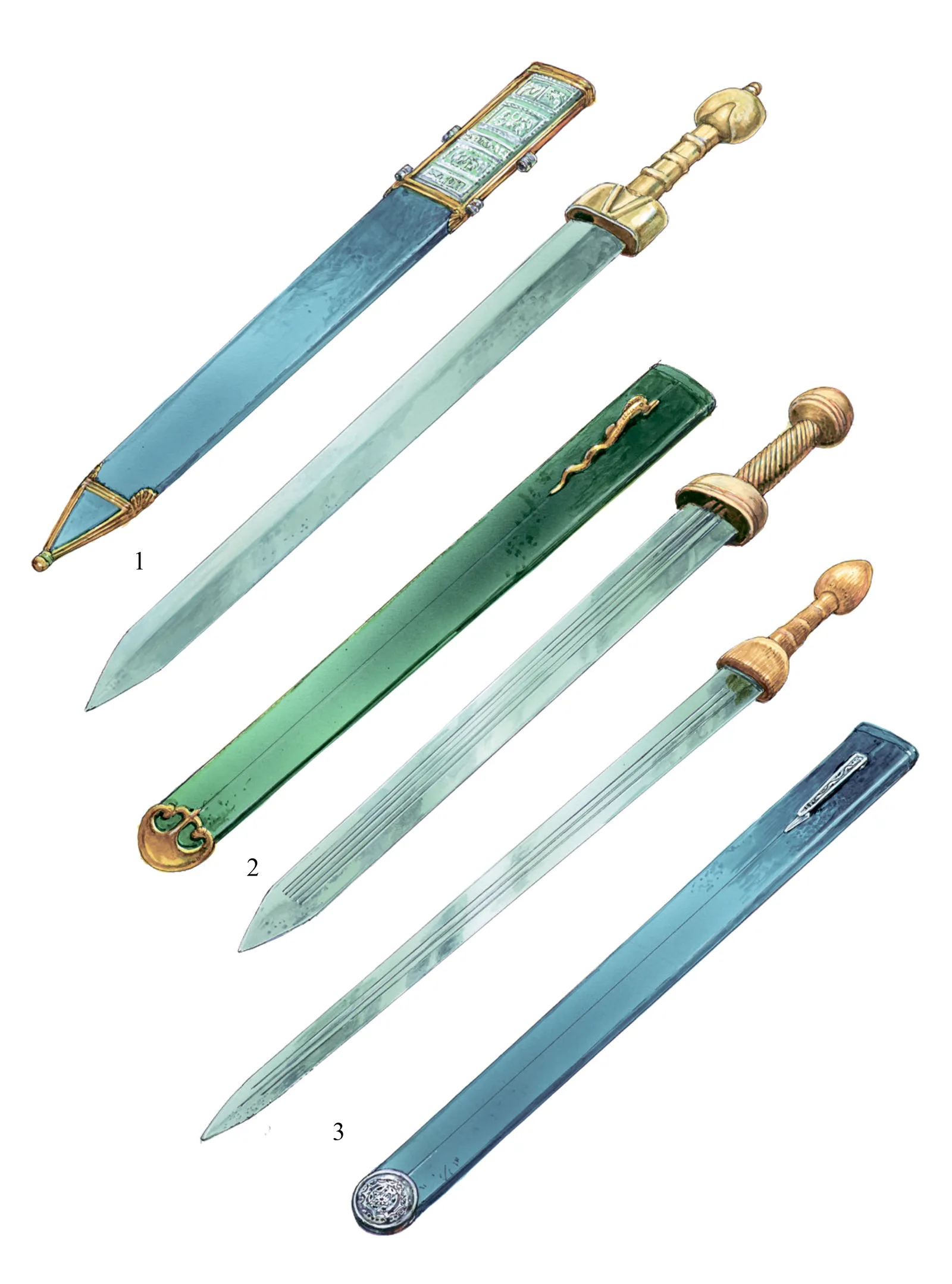
Classification
of Roman spathae (after M. Bishop):
1 – "Pompeii" type; 2 – "Lauriacum/Hromówka" type;
3 – "Straubing/Nydam" type.
Thus, the archaeological
find discussed allows us to speak of quite close contacts between the
population residing in the territory of the Middle Dniester region in the
second half of the 3rd century CE and the Roman Empire in the military
sphere, which occurred in various ways. As a result, Roman-made weapons could
have reached local barbarians both as trophies obtained from major military
confrontations and as rewards after their temporary military service under the
banners of the legions.