Authors: Oksana Dragomyretska,
Andrii Fedoruk
November 11, 2023, marked 350 years since the Battle of Khotyn, where the combined Polish-Lithuanian army led by Grand Crown Hetman Jan Sobieski inflicted a devastating defeat on the Ottoman army commanded by Serasker Hussein Pasha. It so happened that the territory of present-day Chernivtsi region in the early modern period often became an arena for military operations, which most frequently took place directly under the walls of the fortress on the Dniester. However, unlike the Khotyn War of 1621, domestic researchers have barely covered this battle, so important in the history of our region. Although «nothing more was noted about that year in chronicles and Cossack regimental records, only two words – Khotyn War» – thus one of the contemporaries of the event, Ukrainian Hetman's chancellor and Cossack chronicler Samiylo Velychko, began his account of events in Ukraine, «in the year (…) from the Incarnation of the Son of God 1673».
The battle took place as a result of another Polish-Turkish military confrontation, triggered by Sultan Mehmed IV Avcı's capture of all of Podillia and parts of Kyivshchyna in August–October 1672. On October 18, 1672, the Poles were forced to conclude the humiliating Treaty of Buchach. In view of the growing Ottoman threat, Jan Sobieski, in an address to the Sejm, which met in Warsaw in March – April 1673, noted that the Polish-Lithuanian Commonwealth found itself in a much worse position than during the 1621 war, because «Ukraine at that time was ours, as were Podillia, Kamianets, and Khotyn». He proposed to adopt new taxes to create a large army. The Grand Crown Hetman's proposal was supported by King Michał Korybut Wiśniowiecki.
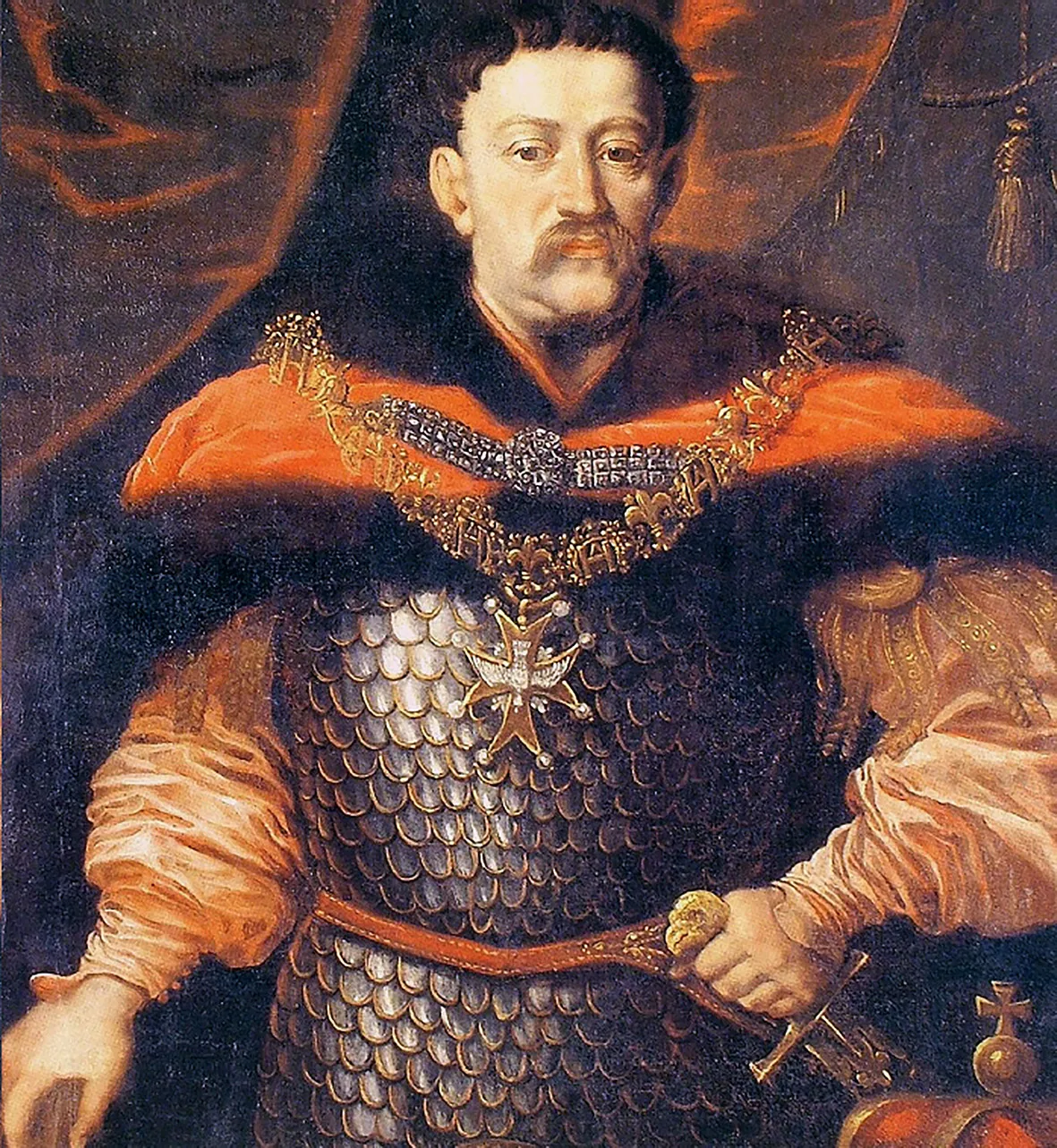
Jan Sobieski.
Artist Daniel Schultz.
At the same time, the Turks also made certain preparations for war. They saw that the Poles, unwilling to properly fulfill the terms of the Treaty of Buchach, were playing a delicate diplomatic game to buy time. On August 7, 1673, Mehmed IV, at the head of a 35–40 thousand-strong army, set out from Edirne to the Danube. There, the Sultan handed over command of it to the Grand Vizier, who, in turn, entrusted the army to the governor of Silistra, Hussein Pasha, who marched with it to Khotyn.
The increased threat from Ottoman troops stationed near the borders of Galicia prompted Polish government circles to intensify their actions. In mid-September, Polish units led by Grand Crown Hetman Jan Sobieski marched from Hrubieszów to Hlyniany, where on October 8, King M. K. Wiśniowiecki inspected the army. Already on November 1, Polish units crossed the Turetska River near Sniatyn and headed to Boyany. Before entering Bukovyna, the commander-in-chief of all forces of the Polish-Lithuanian Commonwealth, Jan Sobieski, strictly forbade the army from plundering the local population and ordered them to buy everything necessary for money. However, the soldiers ravaged villages, taking livestock and bread from the people. To stop these robberies, the Grand Crown Hetman resorted to severe punishments. This became one of the reasons for the increase in the number of deserters from Polish units. Due to heavy rains, the roads became muddy, so the movement of cannons and wagons with ammunition through the area overgrown with dense beech forest was slow. At the same time, the Lithuanian army also moved to Boyany, which, after settling another dispute between Grand Crown Hetman Jan Sobieski and Grand Lithuanian Hetman Mykolas Kazimieras Pacas, crossed the Dniester near Horodenka.
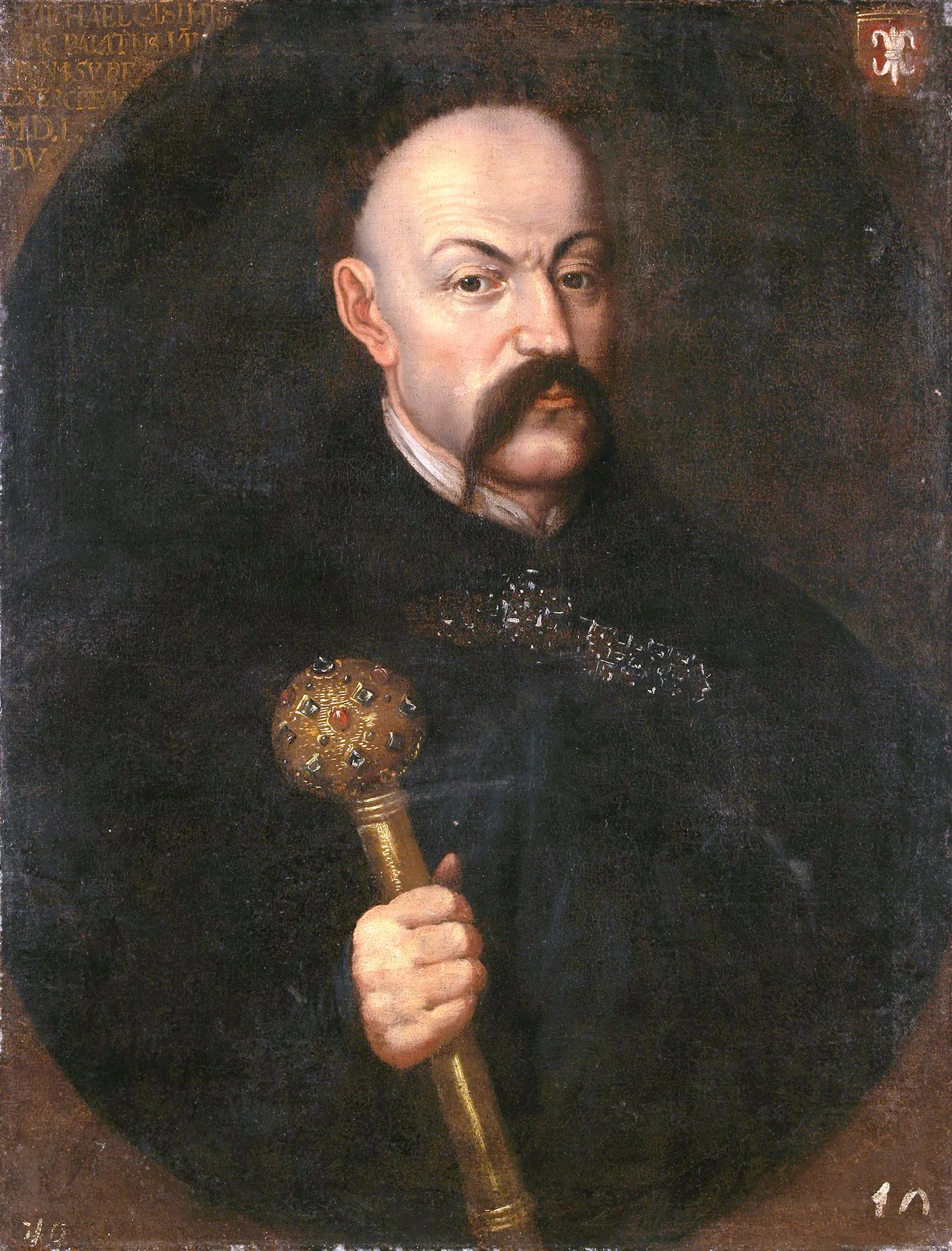
Mykolas Kazimieras Pacas.
Artist unknown.
On November 9, Polish cavalry approached the Ottoman field fortifications near Khotyn. Hussein Pasha's units stood behind the restored ramparts and ditches of the Polish-Lithuanian and Zaporozhian camps from the 1621 war, which were additionally reinforced with a new system of redans about
Polish and Lithuanian cavalry banners stopped before the Turkish ramparts at a distance of «three bowshots». In the evening, the main cavalry forces «retreated from the field to their camps a quarter of a mile (approximately 1.5–
In total, Grand Crown Hetman Jan Sobieski had at his disposal 32,000 soldiers and 66 cannons at Khotyn, including Ukrainian Cossacks under the Right-bank Hetman Mykhailo Khanenko. On the night of November 9-10, the Polish-Lithuanian command held a military council, at which M. K. Pac expressed doubts about the possibility of capturing the Turkish camp and proposed abandoning further active military operations. To this, Jan Sobieski replied that retreating without defeating the enemy meant dooming his own army to destruction. Indeed, lacking sufficient provisions and fodder, it would have to capture the Ottoman fortifications to survive.
On the morning of November 10, Polish and Lithuanian units approached the enemy's fortifications, «now the Turks did not move a step». Then Hetman Jan Sobieski ordered a closer approach to the enemy ramparts and commenced shelling them with cannons. General of Crown Artillery Marcin Kazimierz Kątski, having deployed artillery batteries, began shelling the Ottoman fortifications. While the cannons maintained active fire, Jan Sobieski surveyed the situation, attempting to discern the enemy's intentions. He surmised that Hussein Pasha might launch his units in an attack. Then, on his order, the artillery intensified its fire, and the Ukrainian Cossacks of the acting Hetman Ivan Motovylo and German infantrymen under General Johann Dannemark went on the attack. They swiftly scaled the rampart, overcame the Turkish screen, and broke into the enemy camp. Evidently, Jan Sobieski did not expect such agility from the Cossacks and Germans and therefore did not manage to concentrate the necessary additional forces on this line of attack. The Ottomans managed to repel the enemy's assault, during which Ivan Motovylo died. Leading «the Cossack, Khanenko's army, as revealed by the accounts of old Cossacks who were there, (…) they showed great service to the Polish Crown with their faithful service to the Poles and their knightly hearts». Having suffered heavy losses, General J. Dannemark was also forced to retreat to Polish positions. Although the attack on the Turkish camp ended unsuccessfully, it did allow for the identification of some weaknesses in its defense.
The Grand Crown Hetman decided the next day to lead the entire army in a general assault on the enemy's fortifications. Under cover of night, on the orders of General M. K. Kątski, cannons were moved closer to the Ottoman camp. The night of November 11 was cold, with a biting wind and heavy snow. At dawn, Hetman Jan Sobieski, having walked around the enemy's fortifications and ascertained that most Turkish infantrymen had abandoned their combat positions, decided to launch the assault without delay. After a brief artillery preparation, columns of Polish infantry and camp followers, supported by cavalry units following them, advanced to storm the enemy positions. Giving the order to attack, the Grand Crown Hetman «himself, with a drawn saber, walked on foot before his column and exhorted: «In the name of God's mercy, faith, and churches, in the name of our beloved Homeland, having hope in God, let us advance bravely.» Subsequently, at the urging of several officers, Jan Sobieski rode to an elevated position to further direct the battle.
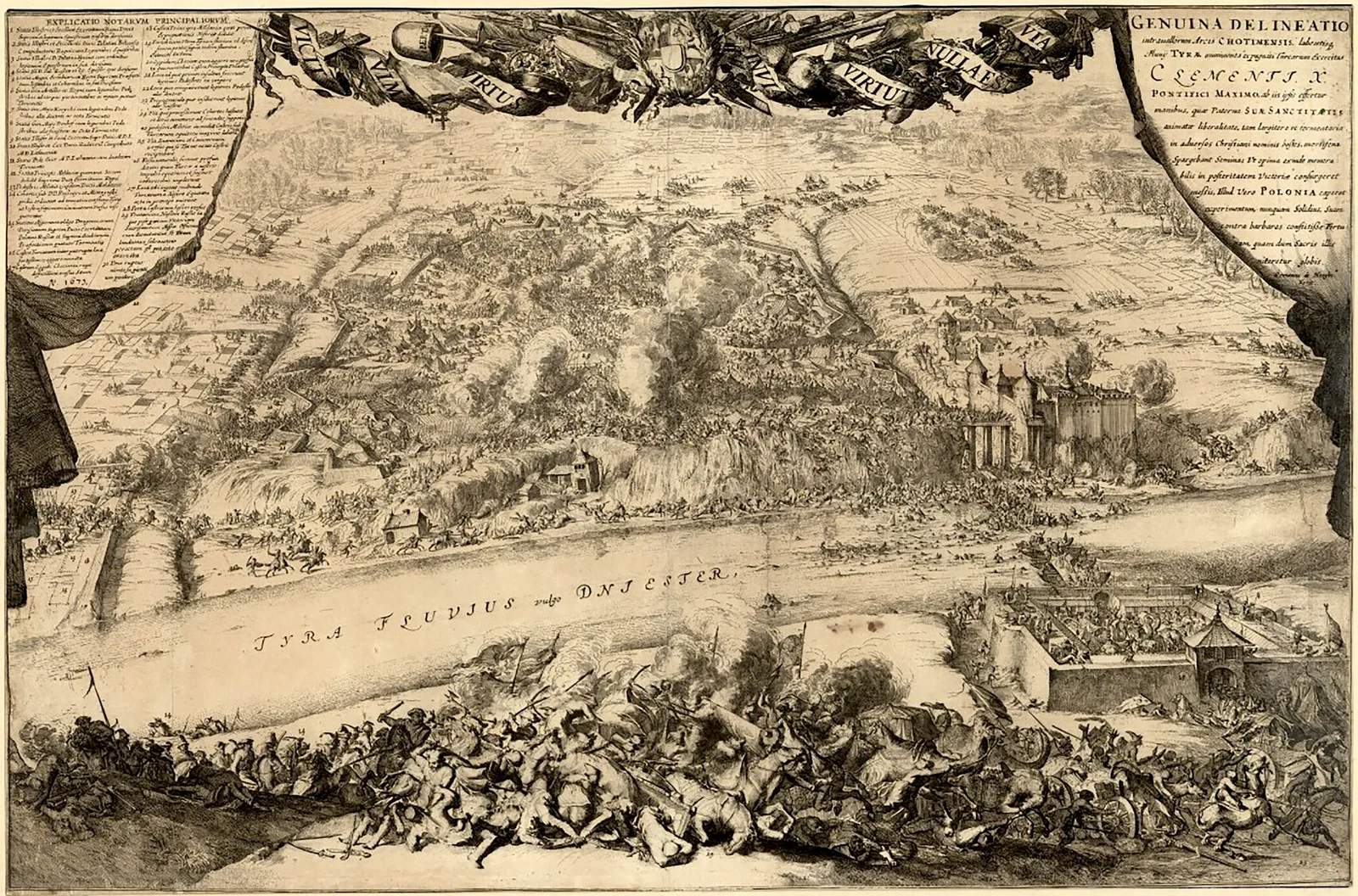
Battle of Khotyn, 1673.
Artist Romeyn de Hooghe.
Inspired by the courageous surge and personal example of their commander-in-chief, the soldiers bravely advanced on the Ottoman ramparts. Despite some losses, the Poles still managed to take the enemy's screen by surprise. The majority of the Turkish infantry, alerted by the alarm, rushed from their tents to the ramparts just as Polish infantry units had already scaled and secured positions on them. By order of the Grand Crown Hetman, the infantrymen dug into the rampart, using the excavated earth to fill the ditch and build platforms for the hussar banners to enter the Ottoman camp.
On the far left flank, Lithuanian infantry and cavalry units successfully broke through enemy positions. Hetman M. K. Pac received the commander-in-chief's order when «a fierce battle had already begun all around». Meanwhile, at the edge of the fortifications' left flank, the soldiers managed to dig into the ramparts, and the armored banners of Poznań ensign Władysław Skórzewski and military guard Michał Zbrożek stormed into the enemy camp, quickly advancing towards the bridge over the Dniester with the aim of cutting off the enemy's retreat. However, on the right wing, the Poles could not bring the full force of their heavy cavalry into battle. The platforms and gates allowed only a limited number of hussar banners to pass through in a short time. Therefore, the Ottomans managed to concentrate a significant group of their cavalry in one direction and counterattack. An especially brutal melee erupted on the bank of the Dniester, during which soldiers fell down from a high cliff, suffering injuries and being dashed.
To support his attacking units, Jan Sobieski committed hussar banners led by Ruthenian Voivode Stanisław Jan Jabłonowski to battle. Meanwhile, the Lithuanian army under M. K. Pac captured the western gate of the enemy camp. The Grand Lithuanian Hetman passed through it with his heavy cavalry and, striking the enemy fighting Polish units from the other side, routed them. It seemed that the Turks had suffered a complete defeat, and Polish-Lithuanian units had penetrated deep into their camp. There, Polish infantrymen, disregarding their commanders' orders, rushed to plunder enemy property. Taking advantage of this, the Ottoman cavalry counterattacked them again, and only a new charge by the hussar banners tipped the scales of success in favor of the Poles.
Panic broke out among the remaining Turkish units, and they began to flee chaotically towards the Dniester. Hussein Pasha and his entourage also crossed the bridge to the Podillian bank of the river. Under these critical conditions, only Suleyman Pasha from Bosnia maintained composure. Gathering the remnants of his cavalry around him, he organized a new counterattack, aimed at the southwestern gate of the camp. However, his path was cut off by reserve hussar banners under the command of Field Crown Hetman Dymitr Jerzy Wiśniowiecki and armored cavalry units led by Kyiv Voivode Andrzej Potocki. The latter dealt a powerful blow to the Bosnian unit and forced a significant part of it back into the camp. However, some Ottoman horsemen managed to break through the ranks of the Polish cavalry and gallop to within «half a pistol shot» of where Jan Sobieski himself stood. The Grand Crown Hetman's life was saved by a counterattack of four hussar banners, supported by Aleksander Niezabytowski's armored cavalry. In clashes with them, Suleyman Pasha's horsemen suffered heavy losses and were pushed back to the Dniester cliffs. As a result, many Bosnians, along with their horses, fell down and perished.
Having captured the rampart of the Turkish camp adjacent to the river, with an artillery battery located on it, the Poles, turning the cannons around, opened fire on the fleeing enemy. The bridge, by which the Ottomans were escaping to the Podillian bank, collapsed under the weight of people and horses, as a result of which many found their end in the cold waves of the river. An eyewitness noted in his chronicle that from Khotyn «barely ten thousand passed across the Dniester to Kamianets, and that naked – such was their defeat». The next day, artillery under General M. K. Kątski began shelling Khotyn Castle. However, its garrison, demoralized by the defeat of the Turkish army beneath the fortress walls, offered no organized resistance. On the morning of November 13, it surrendered at the demand of the Grand Crown Hetman and left the castle the next day on honorable terms. That same day, Polish units occupied the Ottoman entrenchments in front of the bridge on the left bank of the Dniester and captured Zhvanets.
However, a series of further reasons prevented Jan Sobieski from achieving the ultimate goal of the campaign, although, in addition to Khotyn and Zhvanets, Polish units also occupied a number of other cities, blocking the route between Bender and Kamianets, which greatly complicated the situation of the Turkish group in Podillia. But the Poles lacked sufficient military forces and means to reclaim Podillia. Specifically, Grand Lithuanian Hetman M. K. Pac refused further participation in military operations, citing the approach of winter. And Jan Sobieski himself was soon forced to leave Moldova, having learned of the death of Polish King M. K. Wiśniowiecki, who died on November 10, 1673, in Lviv.
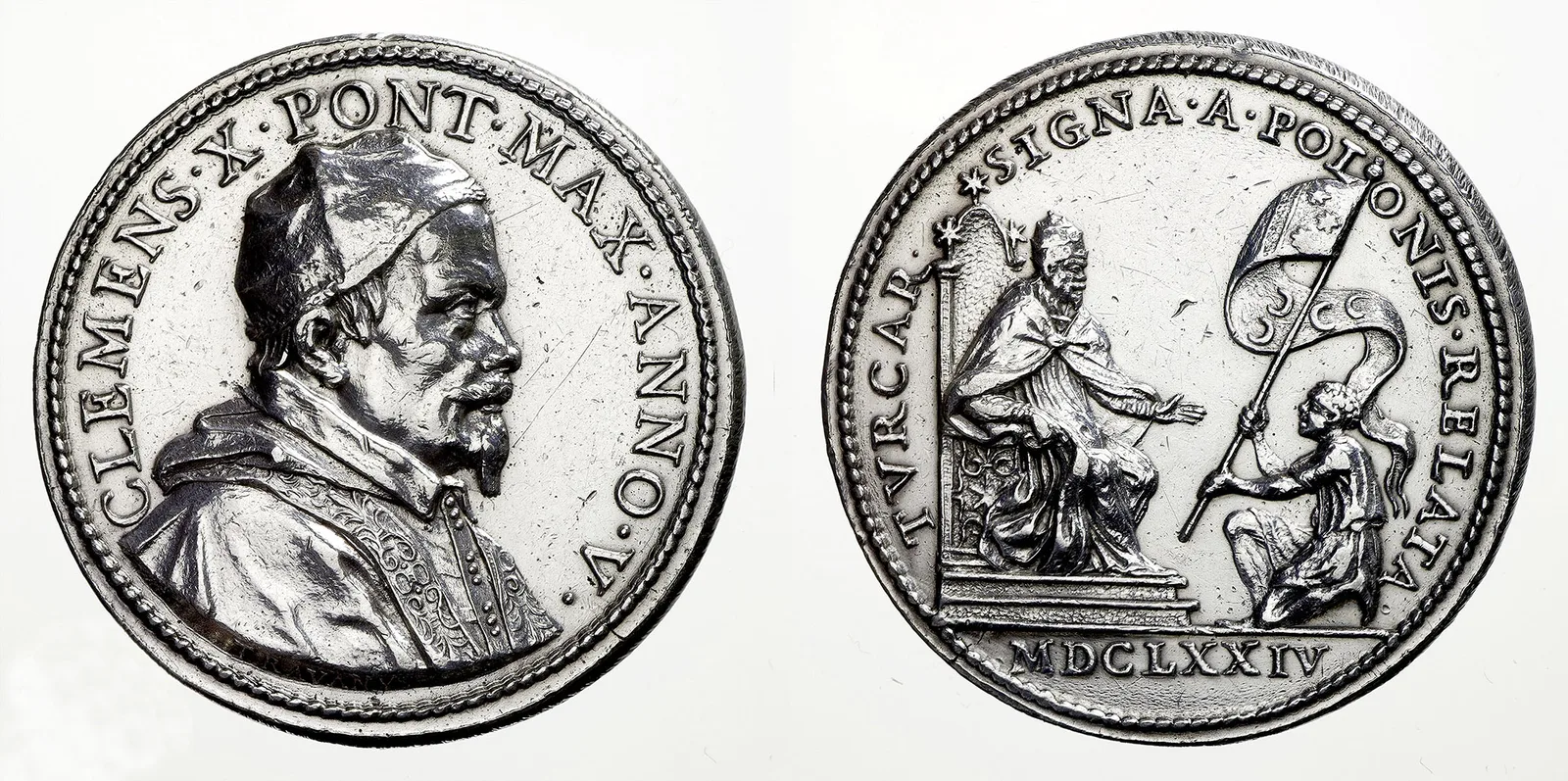
Nevertheless, the Battle of Khotyn made an exceptionally strong impression on the Polish-Lithuanian Commonwealth and neighboring states. The Poles felt as if cleansed of the shame associated with the loss of Kamianets-Podilskyi and the signing of the ignominious Treaty of Buchach. The Grand Crown Hetman returned to his homeland as a triumphant victor and, in essence, as the only real contender for the Polish throne. Naturally, the Grand Crown Hetman made every effort to give the Khotyn victory the widest possible international publicity. The green banner of the Prophet, embroidered with gold patterns and acquired as a precious trophy at Khotyn, Hetman Jan Sobieski himself sent to Rome as a gift to Pope Clement X.